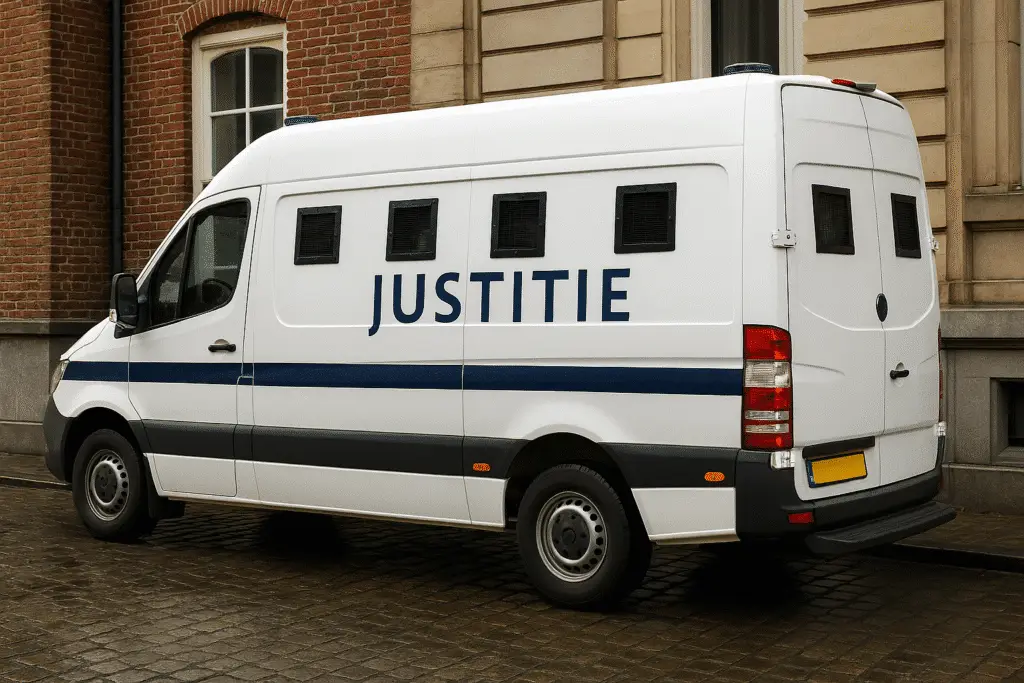
An unconditional sentence (onvoorwaardelijke straf) is a penalty that is actually enforced once the criminal judgment has become final, because the court attached no probation period or conditions to it. The exception is the suspended sentence under Articles 14a to 14c of the Dutch Criminal Code (Wetboek van Strafrecht, Sr), which is only enforced if you break the conditions; a prison sentence of more than four years cannot be suspended at all.
Most Dutch judgments combine the two: part of the sentence is unconditional and part is suspended. Time spent in police custody or pre-trial detention is deducted from the unconditional part under Article 27 Sr.
सामग्री सारणी
What does an unconditional sentence mean?
Unconditional is not a separate type of penalty but a way of imposing one. The court first chooses the penalty and then decides which part, if any, it suspends; everything it does not suspend is unconditional.
Article 9 Sr lists the principal penalties: imprisonment (gevangenisstraf), detention (hechtenis), community service (taakstraf) and a fine (geldboete). The additional penalties are disqualification from certain rights, forfeiture and publication of the judgment. Measures (maatregelen), such as the compensation measure, confiscation of criminal proceeds and TBS, are not punishments but serve redress, removal of illegal profit or public safety.
बिनशर्त शिक्षा आणि स्थगित शिक्षा यांच्यात काय फरक आहे?
The line is drawn by Article 14a Sr. A prison sentence of up to two years may be suspended in whole or in part; for a sentence of more than two and up to four years, at most two years can be suspended; above four years no suspension is possible.
The same power to suspend applies to detention, community service and fines. A suspended sentence always comes with a probation period (proeftijd). Under Article 14b Sr this is at most three years, or up to ten years if there is a serious risk of a new offence against or endangering someone’s physical integrity. The general condition is that you commit no new offence; under Article 14c Sr the court can add special conditions, such as supervision by the probation service (reclassering), a contact or location ban, or treatment.
If a condition is broken, the public prosecutor can ask the court to order enforcement of the suspended part, in whole or in part, or to extend the probation period. Our article on डच स्थगित शिक्षा, तिच्या अटी आणि उल्लंघनाचे परिणाम हे सविस्तरपणे स्पष्ट करते.
| पैलू | बिनशर्त वाक्य | निलंबित शिक्षा |
|---|---|---|
| अंमलबजावणी | एकदा निकाल अपरिवर्तनीय असतो | एखाद्या अटीचे उल्लंघन झाल्यास आणि न्यायालयाने तसा आदेश दिल्यासच |
| उद्देश | प्रतिशोध, समाजाचे संरक्षण, तात्काळ परिणाम | वर्तनाला दिशा देणे, पुनरावृत्ती टाळणे |
| आणि आजार-उपचार | काहीही नाही | कलम 14c Sr अंतर्गत सामान्य अट आणि इतर कोणत्याही विशेष अटी. |
| वैधानिक मर्यादा | नेहमीच शक्य | चार वर्षांपेक्षा जास्त कारावासाची शिक्षा शक्य नाही (कलम 14a Sr) |
| ठराविक वापर | गंभीर गुन्हे, वारंवार गुन्हा करणे, आधीच झालेली हानी | प्रथमच गुन्हा करणारे, असे गुन्हे ज्यात उपचार किंवा देखरेख मदत करू शकते |
Which unconditional penalties can a Dutch court impose?
An unconditional sentence is often not a prison sentence: in most criminal cases it is a fine or a community service order. Each penalty has its own statutory limits.
कैद
Under Article 10 Sr a prison sentence is either for life or for a fixed term. A fixed-term sentence is at most 25 years, or up to 30 years in the cases the article lists, such as offences that also carry life imprisonment.
A life sentence means detention for life in principle. Since 2017 an advisory board for life-sentenced prisoners reviews the position after 25 years of detention; a pardon (gratie) remains the formal route to release.
समुदाय सेवा
Community service is unpaid work under the supervision of the probation service. Article 22b Sr excludes a community service order as the only penalty for certain serious offences, including some violent and sexual offences, and for repeat offending within five years.
The judgment fixes substitute detention (vervangende hechtenis) in case the work is not done properly. Under Article 22d Sr this is at least one day and at most four months, with no more than one day for every two hours of community service.
दंड
Article 23 Sr divides fines into six categories, each with a statutory maximum that is indexed periodically; check the current amounts in the statute. Under Article 24c Sr the court also fixes substitute detention, of at most one year and no more than one day for each full €25 of the fine.
Paying the fine ends the matter. Substitute detention is a means of pressure, not an option you can choose instead of paying.
Driving disqualification and TBS
A driving disqualification under the Road Traffic Act 1994 (Wegenverkeerswet 1994) is an additional penalty and can also be wholly or partly unconditional. TBS under Article 37a Sr is a measure that requires a mental disorder at the time of the offence, a sufficiently serious offence and a need to protect the safety of others; it is often combined with an unconditional prison sentence.
How does the court choose between suspension and immediate enforcement?
Dutch sentencing is discretionary: the Criminal Code sets maximum penalties and almost no minimums. After answering the questions of Articles 348 and 350 of the Code of Criminal Procedure (Wetboek van Strafvordering, Sv) on validity, proof and punishability, the court sets the penalty.
There are no binding tariffs. Courts use the non-binding sentencing guidelines of the judiciary (oriëntatiepunten straftoemeting), and the Public Prosecution Service (Openbaar Ministerie) has its own guidelines for its demand. The prosecutor’s demand is a proposal; the court decides.
Factors that push towards an unconditional sentence are the seriousness of the offence and the harm caused, a recent conviction for a similar offence, and the probation report. Factors that point the other way are a clean record, compensation already paid to the victim and a stable personal situation. A defendant who has spent time in pre-trial detention often receives an unconditional part equal to that period, so no further detention follows. Our article on डच फौजदारी खटल्यातील समन्स आणि सुनावणी explains how the hearing runs.
When is the sentence enforced, and by whom?
An unconditional sentence is enforced once the judgment is irrevocable: when the appeal period has expired unused or the last remedy has been decided. The appeal period is fourteen days under Article 408 Sv, and the period for cassation is also fourteen days under Article 432 Sv.
Since 1 January 2020 the Minister of Justice and Security is responsible for enforcement, in practice through the Central Judicial Collection Agency (CJIB). Fines, compensation orders and calls to report to prison all come from the CJIB.
Do you serve the full prison sentence?
Not always. Under Article 27 Sr the court deducts time spent in police custody and pre-trial detention, so nobody serves the same period twice.
For prison sentences of more than two years, conditional release (voorwaardelijke invrijheidstelling) can be granted after two thirds of the sentence under Article 6:2:10 Sv, for a period of at most two years. Since the Act on punishment and protection (Wet straffen en beschermen) took effect on 1 July 2021 this is no longer automatic; behaviour in detention, risks and the interests of victims are assessed.
What are the financial consequences?
An unconditional sentence often comes with a payment obligation. The most common is the compensation measure (schadevergoedingsmaatregel) of Article 36f Sr, which the court imposes in favour of a victim; the State collects the amount, so the victim does not have to chase the offender.
If the offender does not pay, the court can order coercive detention (gijzeling), which does not cancel the debt. Under the State advance scheme the CJIB pays the victim if the offender has not paid within the statutory period and then recovers the amount from the offender.
Confiscation of criminal proceeds under Article 36e Sr is ordered in a separate decision at the request of the public prosecutor. It is not a punishment but restores the financial position before the offence, so it can be combined with a full unconditional sentence. Cases involving अंमली पदार्थांचे गुन्हे are the typical example.
How can you challenge an unconditional sentence?
You can appeal to the court of appeal within fourteen days (Article 408 Sv). Lodging the appeal in time suspends enforcement, and the court of appeal hears the case again in full.
The court of appeal is not bound by the first sentence and may impose a heavier one, so an appeal against the length of the unconditional part needs advice first. Against the appeal judgment, cassation to the Supreme Court (Hoge Raad) is possible within fourteen days (Article 432 Sv); the Supreme Court only reviews the law and the reasoning, not the facts. Our article on डच फौजदारी कार्यवाहीतील अपील व्यावहारिक पायऱ्या मांडल्या आहेत.
What remains after the judgment is irrevocable?
Three exceptional routes remain. A request for revision (herziening) under Article 457 Sv is filed with the Supreme Court if a new fact (novum) emerges that would probably have led to acquittal or a lesser outcome; disagreement with the assessment of known evidence is not enough.
A pardon request under the Pardon Act (Gratiewet) asks the King, on the advice of the court that passed sentence, to remit or reduce the penalty, usually on grounds that arose after the judgment, such as serious illness. After exhausting domestic remedies you can apply to the European Court of Human Rights in Strasbourg within four months of the final domestic decision.
What should you check if you face an unconditional sentence?
The choice between a suspended and an unconditional sentence is usually decided by what is in the file before the hearing. Check these points as a suspect.
- Read the case file early, including your criminal record and the probation report.
- Offer or pay compensation to the victim before the hearing where possible.
- Collect documents on work, housing, care duties and treatment that show your personal situation.
- Write down the fourteen-day appeal deadline on the day of the judgment.
- Contact the CJIB early about a payment arrangement, and the probation service about the community service schedule.
पीडित म्हणून तुम्ही काय तपासले पाहिजे?
As a victim you can influence how the sentence affects you, mainly through your claim for damages. Check these points before the hearing.
- Join the criminal case as an injured party (benadeelde partij) under Article 51f Sv to claim your direct damage.
- Ask the court to impose the compensation measure of Article 36f Sr, so that the State collects the amount for you.
- Check whether you have a right to speak at the hearing under Article 51e Sv, which depends on the offence.
- Ask the court for a contact or location ban as a special condition if you fear further contact.
- Keep receipts and medical records that prove the amount of your damage.
What are common misconceptions?
Unconditional does not mean prison: many fines, community service orders and driving disqualifications are unconditional. It describes how the sentence is enforced, not how severe it is.
An unconditional sentence can be appealed like any other judgment, within the fourteen-day period of Article 408 Sv. Time in pre-trial detention is not lost: Article 27 Sr deducts it in full, and some defendants leave court on the day of the judgment because the deduction already covers the unconditional part. Dutch law has no parole board and no US-style plea bargain; an out-of-court settlement takes the form of a penalty order (strafbeschikking) by the prosecutor, against which you can object.
What can we do for you with an unconditional sentence?
आमच्या वकिलांमध्ये डच फौजदारी कायदा assist suspects, convicted persons and victims from the first police interview through to appeal and enforcement.
- We review the case file and the probation report before the hearing and identify what can still be added.
- We prepare the plea on the sentence, including a proposal for a suspended part with suitable special conditions.
- We assess the judgment and advise within the fourteen-day period whether an appeal is worth lodging.
- We lodge the appeal or cassation in time and conduct the proceedings.
- We prepare a request for revision under Article 457 Sv or a pardon request where new facts arise.
- For victims, we draft the claim as injured party and request the compensation measure.
आमच्या पेजवर नेदरलँड्समध्ये फौजदारी वकिलाचा खर्च किती येतो explains our fees.
सारांश
- An unconditional sentence is enforced once the judgment is irrevocable; a suspended sentence only after a breach of conditions.
- Under Article 14a Sr a prison sentence of more than four years cannot be suspended.
- Time in police custody and pre-trial detention is deducted under Article 27 Sr.
- Appeal and cassation must be lodged within fourteen days (Articles 408 and 432 Sv); a timely appeal suspends enforcement.
- The CJIB enforces fines, compensation orders and prison sentences on behalf of the Minister of Justice and Security.
सतत विचारले जाणारे प्रश्न
Can an unconditional sentence be combined with a suspended part?
Yes, courts often do this, for example three months unconditional and three months suspended. The suspended part comes with a probation period of at most three years (Article 14b Sr) and can carry special conditions such as treatment or a contact ban (Article 14c Sr).
What happens if I do not carry out my community service?
The substitute detention fixed in the judgment can be enforced. Under Article 22d Sr this is no more than one day for every two hours of community service, with a maximum of four months.
Can an irrevocable unconditional sentence still be changed?
Only in exceptional cases: through revision by the Supreme Court if a new fact emerges (Article 457 Sv), or through a pardon under the Pardon Act. Both are rarely granted.
Is a suspended sentence possible for long prison terms?
No. Under Article 14a Sr a prison sentence of more than four years cannot be suspended, and for sentences of more than two years at most two years can be suspended.