An energy community (energiegemeenschap) is a legal entity that carries out activities on the energy market for its members or shareholders, with environmental, economic or social benefits as its main aim rather than profit. Since 1 January 2026 the डच ऊर्जा कायदा (Energiewet) recognises it in Article 1.1, but it does not exempt it from regular energy law: a supply licence, grid tariffs and congestion still apply unless a specific exception is met.
The key exception allows a community to supply its own members without a licence, but only if it has no more than 500 members or shareholders and does not supply more than it feeds in over a year (Article 2.17(2)(a) Energy Act and Article 2.27 of the Energy Regulation). Below we set out the conditions, the right to share energy, and the main legal risks.
सामग्री सारणी
Which conditions must an energy community meet?
The community must lay down three things in its articles of association, or, for a partnership, in its partnership agreement (Article 2.4(1) Energy Act): participation is open and voluntary, members can leave, and actual control lies with natural persons, micro or small enterprises, municipalities, water authorities, provinces or joint arrangements.
A community that develops renewable energy projects has extra options under Article 2.4(2). It may restrict membership to natural persons, public bodies and small and medium-sized enterprises, place control with members established near its projects, and give every member an equal vote.
Which legal form fits best?
Most initiatives choose a cooperative (coöperatie) or an association (vereniging), because those forms fit open membership and member control. The legal form alone is not enough: the articles and the members’ agreements must actually secure the Article 2.4 requirements, including control that cannot slip to a large investor or market party.
What activities may an energy community carry out?
A community may in principle generate, supply, store, aggregate, provide flexibility services, run charging points and share energy. Each activity is assessed under its own rules: being an energy community does not remove the licence, metering or market rules that apply to that activity.
Article 2.3 of the Energy Act sets general rules for all market participants, and an energy community that is active on the market is bound by them too. Check for each activity whether it counts as supply, aggregation or another regulated activity before you start.
How does energy sharing work?
Energy sharing (energie delen) is a separate statutory right: an active customer, or a connected party within an energy community, may share electricity over the public grid with other participants (Article 2.30 Energy Act). It is not supply, and it does not turn the community into a supplier.
The right only exists if four conditions are met:
- the community has an energy-sharing agreement with a supplier that offers energy sharing;
- every participant has a supply or feed-in agreement with that same supplier;
- every participant has a metering device whose communication function is used (a smart meter);
- electricity is shared per imbalance settlement period.
The civil agreements between participants and the allocation processed by the supplier must match. If they do not, participants receive settlements they cannot explain and the community bears the difference. Rules on the area within which energy may be shared can be set by order in council (Article 2.30(2)).
When does an energy community need a supply licence?
Supplying electricity or gas to end users with a small connection requires a licence from the ACM (Article 2.17(1) Energy Act). An energy community that produces energy may supply without a licence only if all three conditions of Article 2.17(2)(a) are met:
- over a year it supplies no more electricity or gas than it feeds into the grid;
- it supplies only small-connection end users who are its members or shareholders;
- it has no more than 500 members or separate shareholders (Article 2.27 Energy Regulation).
If the community grows beyond 500 members, or supplies more than it generates, the exception ends and a licence or a partnership with a licensed supplier is required. Monitor these figures every year.
What about grid access, tariffs and congestion?
An energy community has access to the grid on non-discriminatory terms but pays grid tariffs. Under Article 3.43 of the Energy Decree (Energiebesluit), tariffs for an energy community must contribute adequately and proportionately to the total costs of the grid; there is no general tariff exemption.
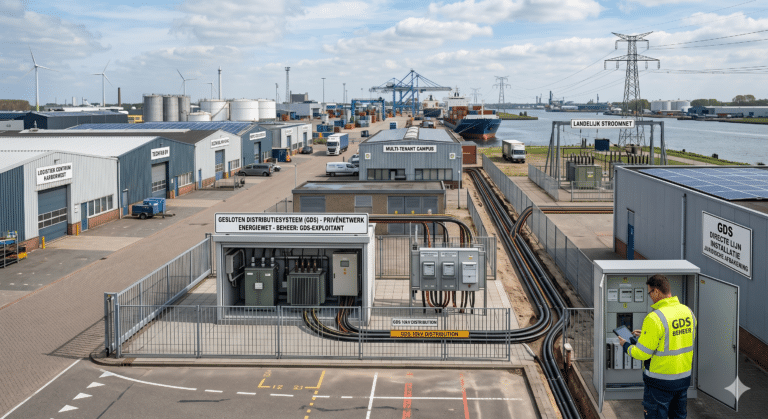
Transport capacity is the third constraint. In areas with grid congestion the grid operator can delay or restrict connections and transport; our article on गर्दी व्यवस्थापन explains your rights. If the project includes its own cables between participants, check whether it falls under the regime for बंद वितरण प्रणाली or direct lines.
Which agreements does an energy community need?
The articles of association are only the start. In practice you need agreements on entry and exit, voting, investment contributions, operation, allocation of generated energy, distribution of benefits, liability and dispute resolution. On top of that come contracts with the supplier (including the Article 2.30 energy-sharing agreement), installers, financiers and the grid operator.
Three risks recur. Governance disputes arise once money is at stake, for instance about admitting new members or the role of a professional partner. Regulatory errors arise when sharing is confused with supply, triggering the licence requirement of Article 2.17. And grid risk arises when the business case ignores connection and transport capacity.
What should you check as initiator or board of an energy community?
- Do the articles secure open participation, the right to leave and control as required by Article 2.4?
- Will you stay at or below 500 members and below your own annual feed-in if you supply without a licence?
- Is there a supplier that offers energy sharing, and has every participant signed with it?
- Do all participants have a smart meter with an active communication function?
- Has the grid operator confirmed connection and transport capacity for the project?
एक सहभागी म्हणून तुम्ही काय तपासले पाहिजे?
- Can you leave the community, and on what financial terms?
- How is shared energy allocated to you and settled on your energy bill?
- What contribution or liability do you take on for investments and losses?
- Do you need to switch supplier to take part in energy sharing?
What can we do for you with an energy community?
आमच्या ऊर्जा वकील advise resident collectives, cooperatives, municipalities and businesses on setting up and running energy communities.
- We draft the articles of association and members’ agreement in line with Article 2.4 of the Energy Act.
- We assess whether your model stays within the licence exception of Article 2.17(2)(a).
- We review the energy-sharing agreement with the supplier and the allocation rules.
- We negotiate agreements with installers, financiers and the grid operator.
- We advise on governance disputes, entry and exit of members.
सारांश
- An energy community is a non-profit legal entity defined in Article 1.1 of the Energy Act; its articles must meet Article 2.4.
- Energy sharing is a separate right under Article 2.30, subject to a supplier agreement, smart meters and sharing per settlement period.
- Supply without a licence is only allowed to members, up to the community’s own feed-in and with no more than 500 members.
- Energy communities pay grid tariffs and remain subject to congestion measures.
सतत विचारले जाणारे प्रश्न
एखादा ऊर्जा समुदाय आपल्या सदस्यांना ऊर्जा पुरवत असेल, तर त्याला पुरवठा परवान्यातून सूट मिळते का?
Only if all conditions of Article 2.17(2)(a) of the Energy Act are met: it supplies no more than it feeds in over a year, it supplies only members or shareholders with a small connection, and it has no more than 500 members or shareholders.
ऊर्जा वाटप आणि पुरवठा यामध्ये काय फरक आहे?
Energy sharing under Article 2.30 of the Energy Act is a right of an active customer or a connected party within an energy community to share electricity via the grid, through a supplier that offers energy sharing. Supply is a separate, licensed activity. The two must be assessed separately.
Does an energy community pay the same grid tariffs as other users?
There is no general tariff exemption. Article 3.43 of the Energy Decree requires tariffs for energy communities to contribute adequately and proportionately to the total costs of the grid.
एखादा ऊर्जा समुदाय स्वतःचे विद्युत ग्रीड उभारू शकतो का?
Possibly, but then the rules on closed distribution systems or direct lines apply. That requires a separate assessment, independent of the energy community status.